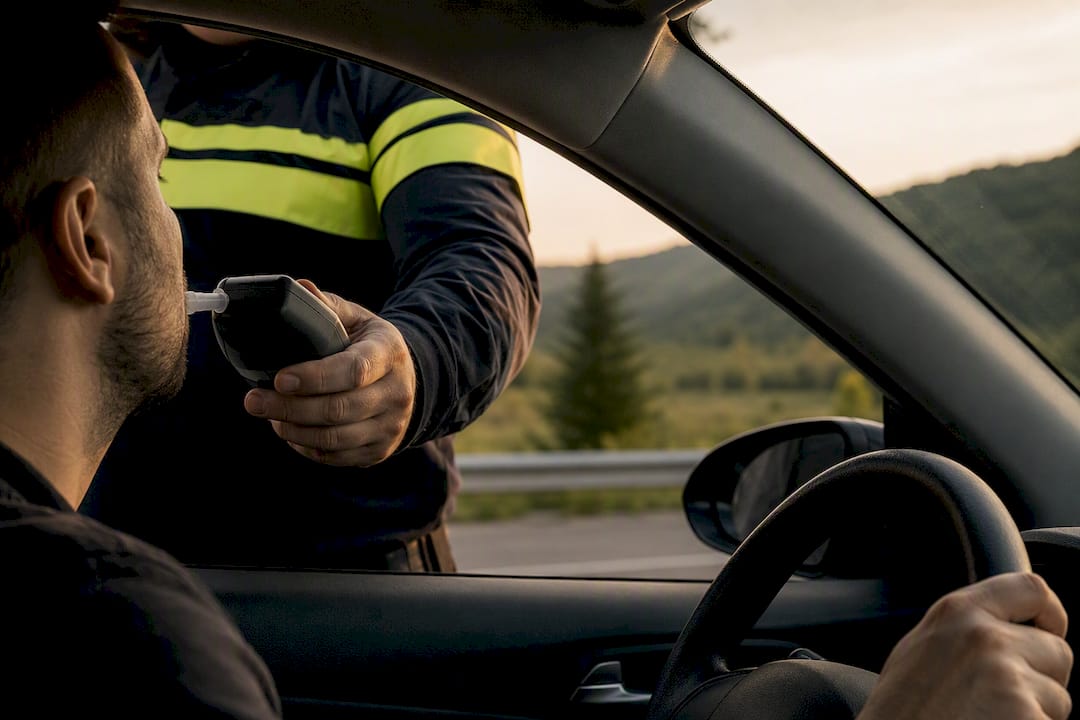
What Is the Legal Alcohol Limit for Drivers in Georgia?
Discover Georgia's legal alcohol limit for drivers and the implications of exceeding it. Stay informed and drive safely.
Trust & transparency
Written by: Georgian APPA Editorial Team
Last reviewed: August 2026 (Reviewed by Georgian APPA)
Georgian APPA separates statutory insurance information from its own customer-facing selling price and links authority pages that explain how content is reviewed and updated.
Official sources used on this page
Cross it, and you are in violation. The country runs a near zero-tolerance system: anything below that threshold is treated as sober, but once measured ethanol climbs above it, penalties kick in fast and scale with how much alcohol shows up in your blood.
Enforcement comes from Road Police officers under the Ministry of Internal Affairs, who can order a sobriety test whenever they have reasonable grounds to suspect impairment, day or night, at any checkpoint.
- A range just above the threshold up to a moderate level triggers a first offense suspension
- Above 0.7‰ (0.07%+ BAC): first offense, 1-year suspension
- Refusing the test: treated as a violation, 1-year suspension
Treat any "safe number of drinks" as a rough guess, not a rule. Body weight, food, and time all shift how alcohol shows up on a breathalyzer.
Key Takeaways
Georgia enforces a low blood alcohol threshold for drivers, with suspensions and fines that increase sharply once alcohol is detected above the legal limit.
| Point | Details |
|---|---|
| Know the numeric limit | Responsibility starts at 0.3‰; above 0.7‰ triggers a 1-year suspension. |
| Expect broad enforcement | Road Police can order a sobriety test on reasonable suspicion, no accident required. |
| Never refuse testing | Refusal carries the same 1-year suspension as a high reading. |
| Carry your documents | Keep your passport, license, and vehicle papers ready, and ask for an interpreter if needed. |
| Insure before you drive | Georgianappa issues compulsory foreign-vehicle insurance online in minutes, valid for 15 days, 1 month, or 1 year. |
Table of Contents
- Do Commercial and Novice Drivers Face Stricter Alcohol Limits in Georgia?
- How Do Different Drinks and Timing Affect Your Measured BAC in Georgia?
- Is Georgia's Alcohol Limit Truly Zero-Tolerance?
- What Actually Happens During a Roadside Stop in Georgia
- Why Compulsory Insurance Matters as Much as Staying Under the Limit
- Where to Verify Georgia's Alcohol and Traffic Laws
- Sources
- FAQ
Do Commercial and Novice Drivers Face Stricter Alcohol Limits in Georgia?
Georgian traffic law does not carve out a separate, higher-tolerance limit for private drivers versus a stricter one for professionals in the way some countries do. The prohibition on driving under the influence applies broadly, and the same 0.3‰ threshold governs responsibility across vehicle categories.
That said, the practical risk is not equal for everyone. Commercial drivers, tour operators, and anyone behind the wheel of a rental car on a foreign license face the same legal exposure as local drivers, but with less margin for error if a stop leads to a language barrier or a dispute over paperwork. If you are driving a rented vehicle or one registered to a tour company, expect officers to check both your license and the vehicle's documentation together.
The law's language also reaches further than passenger cars. Georgia's legislative text on factors affecting fitness to drive explicitly extends the alcohol prohibition to snowmobile operators and even users on ski trails, which tells you the intent is broad coverage of anyone controlling a vehicle or equipment on public infrastructure. If you are picking up a car at Tbilisi or Kutaisi airport for a multi-week road trip, do not assume tourist status buys you any leniency. Georgia's Road Police apply the same numeric threshold to every driver they stop, regardless of where the license was issued.
How Do Different Drinks and Timing Affect Your Measured BAC in Georgia?
Beer, wine, and Georgia's famous *chacha* all raise your blood alcohol differently, and timing matters as much as what you drink. A standard beer, a glass of wine, and a shot of high-proof chacha do not carry equal weight. Chacha routinely runs 40% to 60% alcohol by volume, well above wine's 12% to 14% or beer's 4% to 5%, so a single small pour at a *supra* (the traditional Georgian feast) can push your blood alcohol up faster than a full glass of Saperavi.
Timing compounds the risk. Your liver processes alcohol at a fairly steady rate no matter what you drank, so several glasses of wine consumed quickly at dinner can leave you over 0.3‰ well into the next morning. Georgian hospitality culture often involves long toasting sessions, sometimes with a *tamada* (toastmaster) leading rounds of chacha, and that pacing works against you if you plan to drive home the same night.
Food slows absorption but does not cancel it out. A heavy meal of khachapuri and khinkali alongside your wine will blunt the spike, but it will not bring you back to zero any faster. If you have been drinking at a supra, the safest math is simple: give yourself far more hours than feels necessary before you get behind the wheel, and when in doubt, call a taxi instead of estimating your own blood alcohol.
Is Georgia's Alcohol Limit Truly Zero-Tolerance?
Georgia runs what amounts to a near zero-tolerance system rather than a strict legal zero. The threshold sits at 0.3 per mille, low enough that a single drink can put a smaller-bodied person at risk of crossing it but the law does allow that narrow band below 0.3‰ before responsibility attaches.
What this means in practice: unlike countries that permit a moderate buzz before the legal line, Georgia's margin is thin enough that "just one beer" is not a reliable safety plan. Testing equipment used by Road Police follows standard calibration procedures, and officers are authorized to request a breath test on reasonable suspicion alone, without needing to witness an accident or obvious erratic driving first.
There is no published allowance in the law for equipment margin of error that drivers can rely on as a buffer. Treat the 0.3‰ line as the real ceiling, not a target to approach. Given how the suspension penalties scale sharply once you cross into the 0.3‰ to 0.7‰ band, and jump again above 0.7‰, the only genuinely safe approach for a foreign driver is to avoid alcohol entirely before driving, especially if you are still adjusting to how Georgian portions and pours differ from what you are used to at home.
What Actually Happens During a Roadside Stop in Georgia
Picture this: a Road Police officer waves you over on the highway between Tbilisi and Kazbegi. They will ask for your license, passport, and vehicle documents first, then explain the sobriety test if they suspect anything. Keep your documents within reach, ask for an interpreter if the exchange moves too fast, and note the officer's badge number and the time of the stop. Refusing the test is not a shortcut. It carries its own 1-year suspension, the same penalty as testing well over the limit.
Why Compulsory Insurance Matters as Much as Staying Under the Limit
Staying under 0.3 per mille protects you from suspension and detention. It does not protect you from the financial fallout of an accident, and Georgian law requires valid compulsory third-party insurance for every vehicle on the road, foreign-plated or not. If you are stopped after any driving incident, whether or not alcohol is involved, having that policy in hand changes the entire conversation with Road Police.
Georgianappa handles this from your phone in a few minutes: coverage in 15-day, 1-month, or 1-year terms, an instant digital policy delivered straight to your inbox, and payment processed securely through Stripe. There is no office visit, no paperwork mailed back and forth, and no gap between landing in Tbilisi and being legally covered to drive. For a short Black Sea road trip, pick the 15-day option. For a longer posting or a full relocation, the 1-year term covers you without the hassle of renewing mid-stay. Compare that to figuring out unfamiliar local insurance requirements on the fly in a country where you may not speak the language, and the shortcut is obvious.
Sort your compulsory coverage before you pick up the keys. Buy your policy online and get your confirmation before you leave the rental counter.
Where to Verify Georgia's Alcohol and Traffic Laws
For the full legal text behind everything above, go straight to the primary sources:
- Georgia's law on traffic and driver conduct, the official statute covering impairment prohibitions and testing authority
- Georgia Today's penalty summary, a news breakdown of suspension lengths and repeat-offender fines
- Law of Georgia on Roads, the statutory basis for road-use restrictions supporting enforcement
The Matsne links are official legislative text; the Georgia Today link is journalistic reporting summarizing recent penalty changes.
This article is general information, not a substitute for advice from a qualified lawyer. Consult a qualified legal professional about your own circumstances before acting on anything here.
Sources
- on Traffic | სსიპ ”საქართველოს საკანონმდებლო მაცნე”
- Penalties for Drink-Driving Up, Administrative Detention to be Introduced - Georgia Today
- LAW OF GEORGIA ON ROADS
FAQ
What is the legal alcohol limit for drivers in Georgia?
Readings between 0.3‰ and 0.7‰ bring a 6-month suspension, and above 0.7‰ brings a 1-year suspension.
Does Georgia have zero-tolerance alcohol laws for drivers?
Georgia's 0.3‰ threshold functions as a near zero-tolerance limit, leaving little room for even one drink before a driver risks crossing it.
What happens if I refuse a sobriety test in Georgia?
Refusing a test triggers a 1-year driving suspension, the same penalty applied to a high blood alcohol reading.
Are penalties different for repeat DUI offenses in Georgia?
Do I need car insurance as a foreign driver in Georgia?
Yes, compulsory third-party insurance is required for every vehicle on Georgian roads, and Georgianappa lets foreign drivers buy a policy online with instant digital delivery before they start driving.